
Keeping Arabic Alive Abroad: Let Them Create in It
You sit down to dinner and ask your son or daughter about their day in Arabic. They answer in the language of their school. Then they go back to their screen.
On November 1, 2026, W3Techs counted Arabic as the content language of just 0.6% of the websites whose language it could identify, against 49.5% for English. It's no surprise that they need a stronger reason to choose Arabic.
This article is about keeping Arabic alive abroad in a different way: why Arabic fades even at home, what recent studies say, and how to make it a language your son or daughter creates in, such as an interactive story or a game, instead of a language of orders and homework.
Why do they switch to the school language, even at home?
Because the language they hear and need most wins, not because they don't love Arabic. In a 2025 study in Frontiers in Psychology of Arabic-speaking families in Sweden, a questionnaire of parents of 100 Arabic and Swedish bilingual students followed by interviews two years later, conversation between parents and young people stayed mostly in Arabic. But Swedish use grew because of siblings, the young people's own choices, and Swedish media.
That's a study from Sweden, but it describes what many families know: school, siblings and screens pull the conversation toward the country's language. So saying "speak Arabic" isn't enough. They need somewhere to use it for something they love, and someone who enjoys what they say.
Does speaking Arabic at home hurt their success at a foreign school?
You don't need to give up Arabic for them to do well at school. The same study reports that Swedish schools generally advise parents to use their own language as much as possible with their sons and daughters, and that the parents saw Arabic and Swedish as equally important. That's practice in Sweden, so ask their teacher what your school in your country recommends.
Why aren't orders and lessons enough on their own?
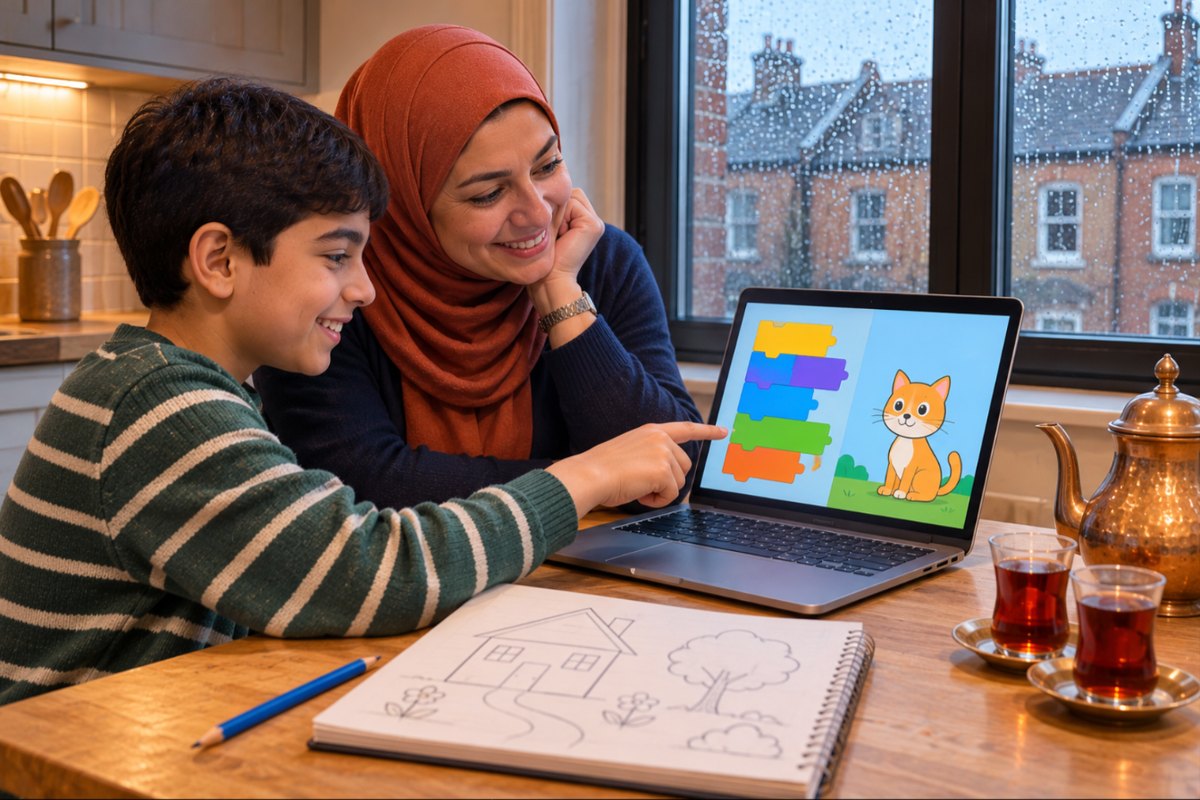
Because a language lives when it has a purpose. A June 2025 opinion paper in Frontiers in Psychology says the family stays central to keeping a heritage language, but can't carry it alone, and that schools, communities and digital platforms share the job. It names apps, storybooks and social media groups among the digital resources that can add access.
And the audience is there. According to Pew Research Center, 1.4 million people aged 5 and older spoke Arabic at home in the United States in 2021, and Statistics Canada reports that Arabic is the mother tongue of about 629,000 Canadians. If your son or daughter makes a game or story in Arabic, it has real players and readers, starting with their grandmother.
How can they make a story or game in Arabic?
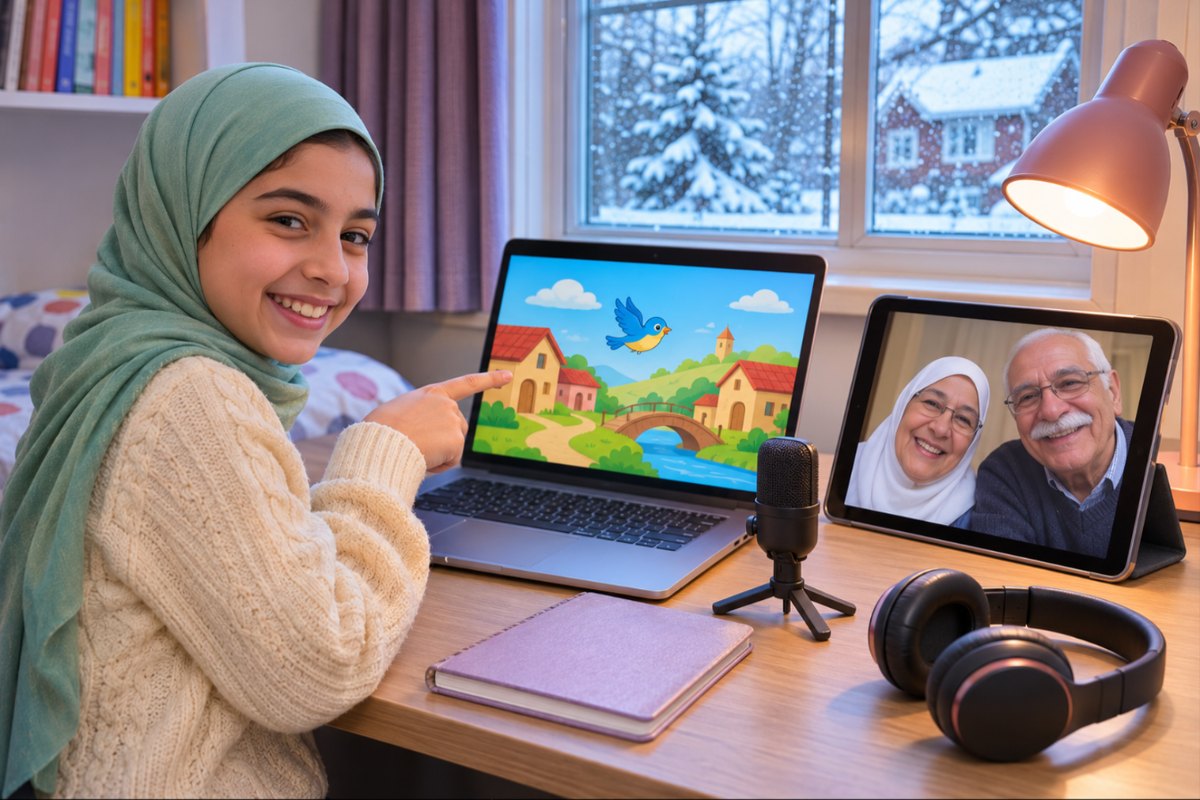
They start with an idea from home, then build a small project that ends with showing it to someone. These steps suit a beginner:
- Pick the idea from the family: a tale their grandmother tells, a proverb, or a summer trip back home.
- They write the text in Arabic: try dialogue in the dialect you hear at home and narration in simple Modern Standard Arabic.
- They build it in Scratch: a free tool where students snap ready-made blocks together without writing complicated code, and there's an Arabic translation of the editor interface.
- They add their grandmother's voice: record a clip and upload it to the project, so everyone who plays hears her dialect.
- They add choices: the player decides what the character does, and that's where they learn the programming condition without noticing.
- They show it: on a video call with relatives, or at a showcase like the online Coolest Projects, whose 2026 edition drew more than 15,000 young creators from 40 countries.
Your part is to be the first audience. Ask about the plot, ask how they made the character move, and let them teach you the tool. When they see you learning from them, Arabic becomes a bridge between you, not an exam.
There's a ready-made date: the world marks Arabic Language Day on December 18 every year, a good moment to show the project to the family.
Read also: Why it helps to learn coding alongside your son or daughter
What project idea suits each age?
Choose an idea smaller than their ambition, because a small project that gets finished encourages the next one:
- Ages 6 to 9: a letter game where each letter they press shows a word that an animated character says aloud.
- Ages 10 to 12: an interactive story with two or three choices, or a quiz about the family's home city.
- Ages 13 to 16: a small game or website in Arabic for relatives and classmates, using a stronger tool like Godot or Python.
Read also: Coding games that build thinking and creativity
What does a real project look like in two weeks?
It looks like four short sessions that end with showing the project to someone. Suppose your son or daughter is 10 and wants to build a story called "Grandmother's House". They could finish it in four half-hour sessions:
- Session one: they write three scenes on paper: arriving at the house, the kitchen and the garden. Their grandmother tells them her best memory of each place over the phone.
- Session two: they draw the backgrounds, add the character and write the sentences in Arabic.
- Session three: they add a choice in each scene: does the character enter the kitchen or the garden? And they upload the recording of their grandmother's voice.
- Session four: they try the story out on a sibling or friends, then show it to their grandmother on a video call.
Afterward, ask: what new Arabic word did you learn, and what will you add in the second story? These questions open a conversation and don't feel like an exam.
What pushes them away from Arabic without meaning to?
Small habits can turn Arabic into a burden. The opinion paper above notes that rules at home are often inconsistent, so start with what you can actually keep up:
- Correcting every mistake mid-project: let them finish, then review the spelling together afterward.
- Using Arabic as a punishment: a line like "write in Arabic instead of playing" ties the language to frustration.
- Comparing them to peers back home: the goal is to write, speak and feel proud of what they made, not to match a school in Cairo or Amman.
- The big project that never ends: a short weekly session beats a huge project that ends in exhaustion.
How does Megaminds Academy help them create instead of only consume?
At Megaminds Academy, we teach students aged 6 to 16 coding and game design, robotics and AI in live online classes, in small groups with certified instructors, and each course page lists the classes as Arabic and English. Every student builds real projects and earns an accredited certificate after each level. Suggest they draw their project from family stories.
Frequently asked questions about keeping Arabic alive abroad
Do they need to know coding to make a story in Arabic?
No. Scratch is built on ready-made blocks you snap together without writing complicated code, so they can start with a short story of three scenes and pick up the programming logic as they go.
Should I speak only Arabic with them at home?
The Swedish study reports that schools there advise parents to use their own language as much as possible. That doesn't mean banning the school language: each language can have its place, and Arabic can have a steady place at home.
What if they make spelling mistakes?
Let them finish the project first, since what matters is that they write and feel proud of what they made. Then review the text together in a calm moment, fixing a few words each time rather than every mistake at once.
In the end, Arabic abroad doesn't need more orders. It needs a daily reason to be used. When your son or daughter makes something in it that others can see, it becomes a language they're proud of, not a duty to finish.
Book a trial class and let them build their first project in their own language.