
Top Coding and Robotics Competitions for Kids Worldwide
In August 2026, an Egyptian team came home from a robotics championship in China with top placements, after a contest of more than 5,000 students and 2,300 teams from 42 countries, Youm7 reported.
A story like that might leave you wondering: could my son or daughter take part? Where would we even start?
The good news is that coding and robotics competitions for kids now start from around age 6, and most don't expect participants to be top performers from day one. This guide covers the best-known competitions worldwide, the ages each one accepts, how to choose, and how to prepare step by step.
What are coding and robotics competitions?
They're events where students solve technical problems or present projects they've built, alone or in teams, before judges or within a set test. Some are showcases with no ranked winners, and others are contests run online or at national level.
Why are these competitions worth the time?
The real value isn't the medal. It's the road to it. Students come away with:
- A clear goal: a fixed date and a real project give learning a purpose.
- Teamwork: sharing roles, debating ideas and taking responsibility.
- Problem-solving under pressure: the robot stops working minutes before judging. Now what?
- Confidence: explaining a project to a panel is an experience that stays with them.
Read also: The Power of Robotics: Unlocking Creativity and Problem-Solving
What are the best-known coding and robotics competitions?
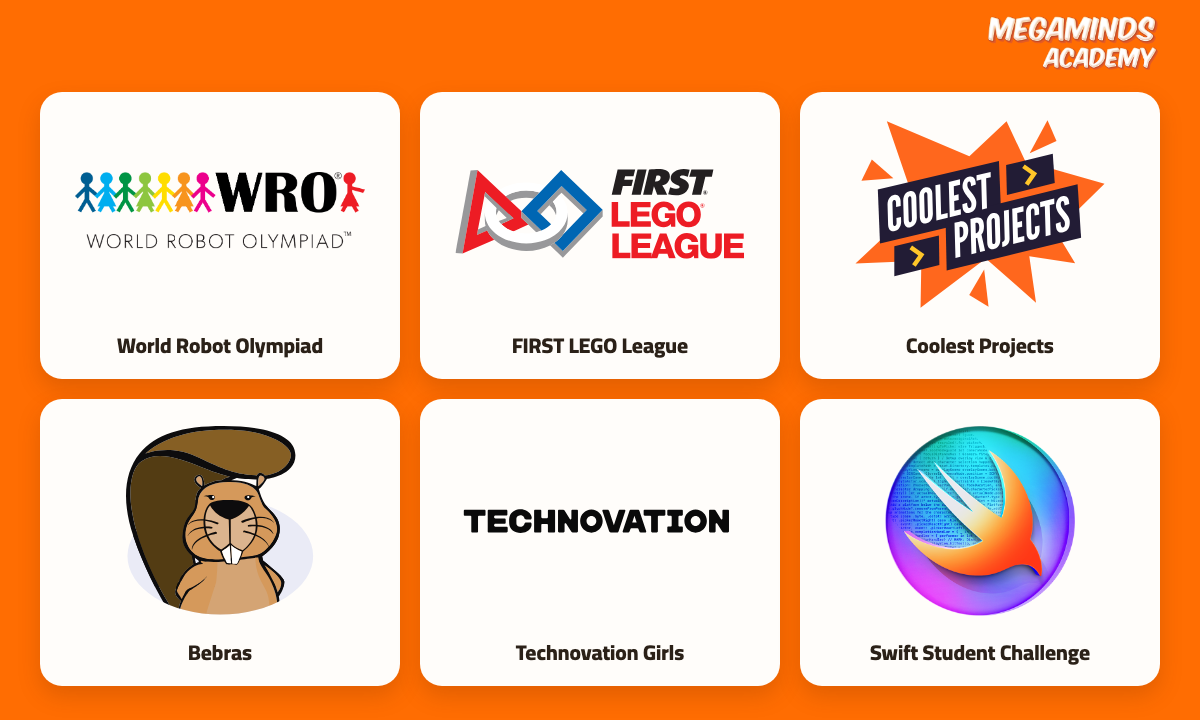
Dates and categories change every year, so check each competition's official website before registering, and confirm it's available in your country.
1. World Robot Olympiad (WRO)
One of the largest robotics competitions for students, with teams from more than 100 countries. The 2026 international final takes place December 8 to 10 in San Juan, Puerto Rico.
- Robo Mission and Future Innovators: ages 8 to 12, 11 to 15, and 14 to 19.
- Robo Sports: ages 11 to 19.
- Future Engineers: ages 14 to 22.
- WRO Starter: ages 6 to 10 in some countries.
2. FIRST LEGO League
A global program where teams build and code a LEGO robot alongside a research project. The 2026/27 BIOGLOW season is the last under the FIRST and LEGO partnership, and LEGO Education launches LEGO League in August 2027 for students aged 5 to 16.
3. Coolest Projects
A global showcase from the Raspberry Pi Foundation rather than a traditional contest. The 2026 online edition drew more than 15,000 young creators from 40 countries, with categories including Scratch, web, games, mobile apps and AI. It's an excellent first experience.
4. Bebras
A computational thinking challenge built on logic problems, with more than 4.2 million participants from 78 countries between November 2025 and April 2026. Age groups vary by country.
5. Technovation Girls
A global program for girls, where teams of 1 to 5 build an app or AI project that solves a problem in their community. Divisions are ages 8 to 12, 13 to 15, and 16 to 18.
6. Swift Student Challenge
An annual Apple challenge where students build an interactive project in Swift. Apple has announced its 2026 winners, so watch the official site for the next edition and its age rules.
Read also: Young Coders Who Inspired the World: 5 True Stories
How do you choose the right competition by age?
Start from their age and current level, not from how famous the competition is:
- Ages 6 to 9: Coolest Projects in the Scratch category, or beginner divisions of WRO and LEGO where available.
- Ages 10 to 12: WRO Robo Mission, FIRST LEGO League, Bebras, or the youngest Technovation Girls division.
- Ages 13 to 16: higher WRO categories, Technovation Girls, or Coolest Projects in advanced programming or AI.
For a first entry, pick a showcase or an online contest. There's usually less pressure and lower cost.
How can they prepare, step by step?
Good preparation starts months ahead and follows these steps:
1. Learn the fundamentals
Start with Scratch or Python depending on age, and learn robotics basics if the competition calls for it.
2. Read the rules early
Every competition has requirements for age, team and tools. Reading them early prevents last-minute surprises.
3. Build one small, complete project
A small project that works beats a big one that never gets finished. Tie it to a real problem they know.
4. Test, then test again
Try the project in different conditions, note what breaks, and fix it themselves.
5. Practice presenting
Have them explain the idea in two minutes at home: what's the problem, how did they solve it, and what did they learn?
Read also: Learning Arduino Programming From Scratch
What are the common mistakes when preparing?
Many teams fall into mistakes that are easy to avoid once you know about them:
- Starting late: a few weeks usually isn't enough to build and test a project.
- A project bigger than the time available: a simple, finished idea is better.
- Adults doing the work: help and ask questions, but the project stays theirs.
- Neglecting the presentation: a good project still needs a clear explanation for the judges.
- Neglecting sleep and school: balance is part of preparing.
How can you support them without pressure?
Your role matters even without a technical background. Here's how you can help:
- Praise effort before results: "I liked how you kept at that bug" lands better than "you're a genius".
- Plan the time together: a simple schedule that fits the project, school and rest.
- Leave the technical decisions to them: even when you can see a faster way.
- Be their first audience: listen to the pitch and question them like a judge.
Read also: Managing Time Effectively for a Healthy Balance Between Study and Play
What if they don't win?
Most participants don't win a medal, and that doesn't reduce the value of the experience. They built a project, presented it, and learned from their mistakes. Afterward, ask: what's the biggest thing you learned, and what would you do differently next time? Those two questions matter more than the final ranking.
What if the competition isn't available in your country?
Check the official site for a local organizer, since some competitions run through partners in each country. If there's none nearby, start with an online option like Coolest Projects, or organize a small project day with their friends. What matters is that they build, present, and get honest feedback on what they built.
How does Megaminds Academy help build these skills?
At Megaminds Academy, we teach students aged 6 to 16 coding, robotics and AI in live online classes, in small groups with certified instructors. Every student builds real projects and earns an accredited certificate after each level, using the same skills any competition asks for.
Frequently asked questions about coding and robotics competitions
What age is right for robotics competitions?
Some programs start at 5 or 6, such as the upcoming LEGO League and WRO Starter in some countries. Most students are better prepared from around age 8 to 10, after learning the basics.
Do they need an expensive robot to take part?
Not always. Bebras and Coolest Projects don't require a robot at all. Robotics contests do specify their equipment, so check the rules before buying anything.
Are there online coding competitions?
Yes. Coolest Projects runs online, and other contests are held remotely, such as the one where Egyptian student Martyros Mina reached the gold level in 2026.
Finally, a competition isn't the end goal. It's an enjoyable way to turn learning into a project with a date and an audience. Start with a small step that fits their age, and the steps will grow with them.
Book a trial class and let them build the first project they enter.